HONEYCOMBS IN TIMBER
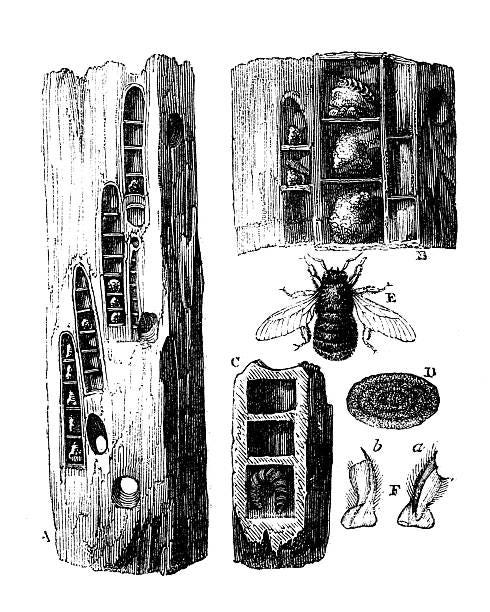
Among the many interesting facts concerning bees which attract the attention not only of naturalists, but of other persons acquainted with country life, is the existence of honeycombs in timber. The little workers select their dwellings in accordance with instincts which are yet but little understood: penetrating through or into solid substances by means apparently very inadequate to the work to be done. M. Raumur proposed the name of carpenter bees to denote those which work in wood, to distinguish them from the mason bees that work in stone, and the mining bees that work underground. Mr. Rennie (Insect Architecture) says:
‘We have frequently witnessed the operations of these ingenious little workers, who are particularly partial to posts, palings, and the woodwork of houses which has become soft by beginning to decay. Wood actually decayed, or affected by dry rot, they seem to reject as unfit for their purpose: but they make no objections to any hole previously drilled, provided it be not too large.’
It is always, so far as is known, a female bee that thus engages in carpentry. Mr. Rennie describes one which he saw actually at work:
‘She chiseled a place in a piece of wood, for the nest, with her jaws; she gnawed the wood, little bits at a time, and flew away to deposit each separate fragment at a distance. When the hole was thus made, she set out on repeated journeys to bring pollen and clay: she visited every flower near at hand fitted to yield pollen, and brought home a load of it on her thighs: and alternated these journeys with others which resulted in bringing back little pellets of clay. After several days’ labour, she had brought in pollen enough to serve as food for the future generation, and clay enough to close up the door of her dwelling.”
Several days afterwards, Mr. Rennie cut open the wooden post in which these operations had been going on. He found a nest of six cells:
“the wood formed the lateral walls, but the cells were separated one from another by clay partitions no thicker than cardboard. The wood was worked as smooth as if it had been chiseled by a joiner.”
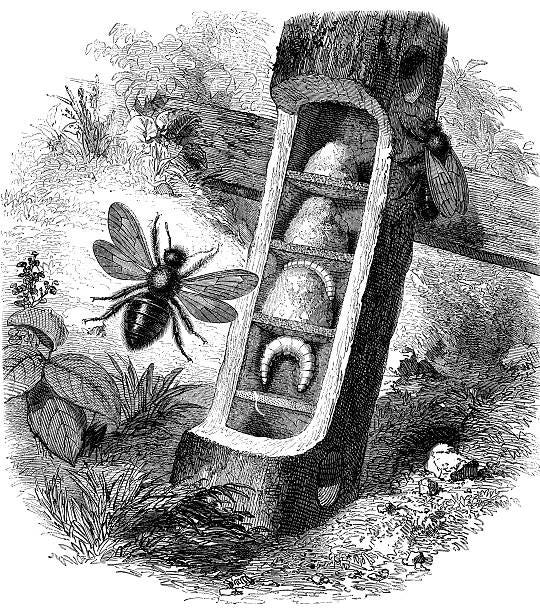
Such instances are of repeated occurrence, more or less varied in detail. Thus, on the 10th of March 1858, some workmen employed by Mr. Brumfitt, of Preston, while sawing up a large solid log of baywood, twenty feet long by two feet square, discovered a cavity in it about eight feet long, containing a fully formed honeycomb. Many carpenter bees dig perpendicular galleries of great depth in upright posts and palings. Reaumur describes a particular kind, called by him the violet carpenter bee (on account of the beautiful colour of the wings), which usually selects an upright piece of wood, into which she bores obliquely for about an inch, and then, changing the direction, works perpendicularly for twelve or fifteen inches, and half an inch in breadth. She sometimes scoops out three or four such channels in one piece of wood. Each channel is then partitioned into cells about an inch in depth; the partitions being made in a singular way from the sawdust or rather gnawings of the wood.
The depositing of the eggs, the storing of them with pollen, and the building up of the partitions, proceed in regular order, thus. The bee first deposits an egg at the bottom of the excavation: then covers it with a thick layer of paste made of pollen and honey: and then makes over or upon this a wooden cover, by arranging concentric rings of little chips or gnawings, till she has formed a hard flooring about as thick as a crown-piece, exhibiting (from its mode of construction) concentric rings like those of a tree, and cemented by glue of her own making. She deposits en egg on this flooring or partition, then another layer of soft food for another of her children, and then builds another partition—and so on, for a series of perhaps ten or twelve in height. Few things are more wonderful in their way than this: for the little worker has no tools but two sharp teeth to help her; she bores a tunnel ten or twelve times her own length quite smooth at the side: and makes ten or twelve floors to her house by a beautiful kind of joinery. This labour occupies several weeks. The egg first deposited develops into a grub, a pupa, and a perfect bee earlier than the others: and the mother makes a side door out of the bottom cell for the elder children to work their way out when old enough; they can penetrate the partitions between the cells, but not the hard wood of a piece of timber.
So ends the March 10th edition of The Quirky Almanac.
See you tomorrow for some more bemusement!
Excerpted from The Book of Days, A Miscellany of Popular Antiquities, in connection with The Calendar including Anecdote, Biography, & History, Curiosities of Literature and Oddities of Human Life and Character, 1869, edited by R. Chambers. Vol. 1, pages 353-355, 1878 edition in two vols.
Thanks for reading! Subscribe to receive daily and bemusing posts from The Quirky Almanac!