SIR ISAAC NEWTON
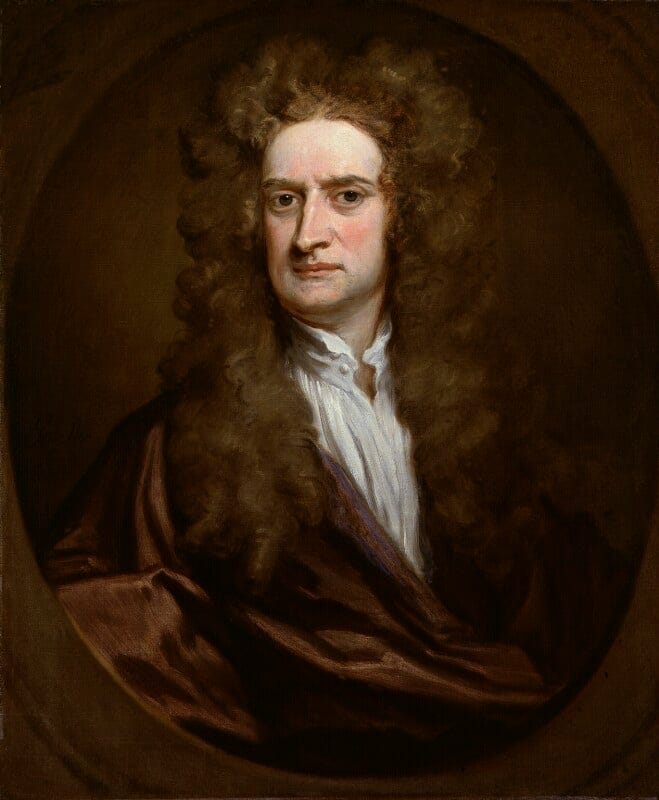
Editor’s note: Many of us know Sir Isaac Newton for his famous scientific experiments. However, he was also a government bureaucrat, serving as the Warden of the Mint, appointed in 1696; he held the position for 30 years. Even famous scientists had to pay the bills.
His signature has proved to be a valuable commodity on the auction market. The image of his signature provided below is taken from a document concerning the financing of the mint, when new coins needed to be struck. Sir Isaac had to sign the warrant for the issuance. I am not 100% positive that this is the autograph referred to by the original editor of The Book of Days. I do believe it is highly probably since it appears this item has been on the public market for a long time.
This warrant from August 14, 1717, sold in 2015 at auction for $33,245. In addition to its being the autograph of a famed scientist, it was also important for its connection to important numismatic content. See a full description of the item here: https://www.rrauction.com/auctions/lot-detail/33451300458292-isaac-newton/
And now to the entry on it from The Book of Days.
It was an equally just and generous thing of Pope to say of Newton, that his life and manners would make as great a discovery of virtue and goodness and rectitude of heart, as his works have done of penetration and the utmost stretch of human knowledge. Assuredly, Sir Isaac was the perfection of philosophic simplicity. His plays in childhood were mechanical experiments. His relaxations in mature life from hard thinking and investigation, were dabblings in ancient chronology and the mysteries of the Apocalypse. The passions of other men, for love, for money, for power, were in him non-existent: all his energies were devoted to pure study. Sir David Brewster, in his able Life of Newton, has successfully defended his character from imputations brought upon it by Flamsteed. He has also, however, printed a letter attributed to Sir Isaac—a love-letter—a love-letter written when he was sixty, proposing marriage to the widow of his friend Sir William Norris. It is quite impossible for us to believe that the author of the Principia ever wrote such a letter, until more decisive proof of the fact can be adduced, and scarcely even then.
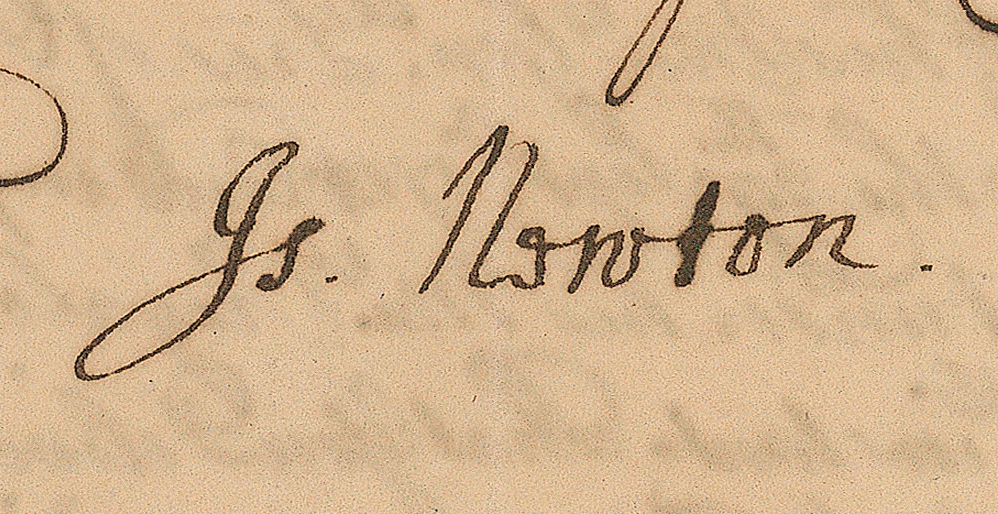
The subjoined autograph of Sir Isaac is furnished to us from an unedited letter. It precisely resembles one which we possess, extracted from the books of the Mint, of which Sir Isaac was master.
So ends the March 20th edition of The Quirky Almanac.
See you tomorrow for some more bemusement!
Excerpted from The Book of Days, A Miscellany of Popular Antiquities, in connection with The Calendar including Anecdote, Biography, & History, Curiosities of Literature and Oddities of Human Life and Character, 1869, edited by R. Chambers. Vol. 1, pages 395-400, 1878 edition in two vols.
Thanks for reading! Subscribe to receive daily and bemusing posts from The Quirky Almanac!